

He Changed American History While He Was In Prison!

Published in January - 2026
YES! You’re getting #22 (Lifted By The Wings of Destiny) THIS month!
I’m in the final push and feeling great! I’ve decided to not do a pre-order this time. Instead, the day I release it will begin 1 week of signups for an exciting new contest (details to come). The winners will be announced 1 week after Release Day.
So, when IS release day? That will remain a mystery for the next 2 weeks. 😜 I can tell you that you want to watch for my next BLOG so that you don’t miss being able to enter the contest.
I am beyond grateful that I’ve stayed well. I am beyond grateful for all of you who have written to encourage me. I am beyond grateful for all who have prayed, sent good energy, and believed I could do this.
And, I know the question is already rolling through your mind... YES, there will be a #23. The outline is already coming to life in my mind, but the best you’ll get from me is that it will be published this year! It’s been a while since I was healthy enough to release 2 books in one year. I believe 2026 is the year!
I have a special story to share with you before I dive back into finishing this new book. When I learned about this, I realized there are many things I hear every day, but have no idea where the saying came from. I love to do research behind words and sayings, but this one had escaped my attention.
The power of this story struck me hard.
Perhaps because so many of us are feeling powerless right now. No matter which side of the political spectrum you are on, it is becoming increasingly evident that America is spiraling out of control.
Different people have different perspectives on it. I certainly have a perspective, but I don’t believe I’m needed to articulate it. What I DO believe is that I am meant to articulate just how you are meant to LIVE through this time.
Navigating this time in history is going to require great courage.
It’s going to require educating yourself and choosing to carefully think through your beliefs and actions.
It’s going to require a commitment to determination - refusing to give up on what you believe in and hold dear.
It’s going to require an inordinate amount of compassion.
You know, I wrote that last line, and realized part of it isn’t true. Inordinate. That means more than usual. That’s the word I realize I don’t believe is true. There has NEVER been a time in history that didn’t require an inordinate amount of all the things I just wrote. Which means, I suppose, that all of these things are simply the way we should live ALL the time.
There are plenty of people talking about all the thnigs going wrong right now. Rather than point out and expose all the reasons you need to have courage, education, clear thinking, determination, compassion, and HOPE, I believe my purpose is to empower you to have these things!
I do that for myself by learning about people who have done the very thing I aspire to. I’ve been deliberately doing it for decades. There are thousands of people who have inspired me over the years. I have yet to come close to running out of people I want to research and write about. I have a list of over 400 people right this minute. There will be far more than that. Our world has always been full of extraordinary people.
I dive into their lives as a way to empower and enhance my own. I’ll share as many of them with you as I can!
I didn’t write this one, but I can’t find who to credit. I just know it’s important to share!
HE CHANGED HISTORY WHILE IN PRISON
In 1961, a man with an 8th-grade education picked up a pencil in his prison cell and accidentally changed American history forever.
Clarence Earl Gideon was nobody special. At 51, he was a drifter with gray hair, weathered skin, and a lifetime of hard luck. He’d bounced from town to town doing odd jobs, barely scraping by, occasionally spending time in jail for minor offenses. He never finished school. He never had money. And on August 4, 1961, when he stood in a Florida courtroom accused of breaking into a pool hall, he didn’t have a lawyer.
The evidence against him was razor-thin—someone claimed they saw him near the Bay Harbor Pool Room around 5:30 AM with coins in his pocket. Five dollars in change was missing from the building, along with some beer and soda. That was it. Gideon swore he was innocent, but who was listening to a poor drifter with a criminal record?
When his trial began, Gideon made what he believed was a simple, constitutional request: “Your Honor, I request this court to appoint counsel to represent me in this trial.”
The judge’s response was polite but devastating: “Mr. Gideon, I am sorry, but I cannot appoint counsel to represent you in this case. Under the laws of the State of Florida, the only time the court can appoint counsel to represent a defendant is when that person is charged with a capital offense.”
Think about that for a moment. The American legal system—with all its complexity, its procedural rules, its technical language—was asking a man who never finished middle school to defend himself against trained prosecutors. They expected him to understand evidence law, cross-examine witnesses, and protect his own constitutional rights.
Gideon tried his best. He questioned witnesses. He proclaimed his innocence. But how do you defend yourself when you don’t speak the language of the law? The jury found him guilty. On August 25, 1961, Judge Robert L. McCrary sentenced him to the maximum: five years in Florida State Prison.
Most people would have given up. But Clarence Earl Gideon wasn’t most people.
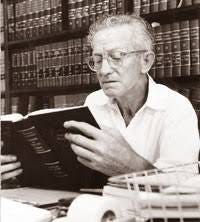
In the prison library, surrounded by law books he could barely understand, Gideon began to read. Slowly, painfully, he taught himself about the Constitution. He discovered the Sixth Amendment’s promise of “assistance of counsel.” He learned about the Fourteenth Amendment’s guarantee of due process. And he realized something that burned in his chest: the system was fundamentally broken.
How could justice exist when rich defendants got lawyers but poor ones faced prosecutors alone?
Gideon filed a petition with the Florida Supreme Court. They rejected it without comment.
So he picked up his pencil again. In shaky handwriting on prison stationery, across five hand-printed pages with imperfect spelling, he wrote a petition to the United States Supreme Court. He signed it. He folded it. And on January 8, 1962, one poor prisoner’s voice reached the highest court in America.
Against every odd imaginable, they listened.
The Supreme Court receives thousands of petitions every year. Most are dismissed without a second glance. But something about Gideon’s case struck a chord. On June 4, 1962, they agreed to hear his appeal. And because he couldn’t afford an attorney, they appointed him one of the finest lawyers in the country: Abe Fortas, who would later become a Supreme Court Justice himself.
On January 15, 1963, Fortas made an argument so simple it was devastating: If Clarence Darrow—perhaps the greatest criminal attorney in American history—hired a lawyer when he was charged with a crime, how could a man with an eighth-grade education possibly defend himself?
The answer was obvious. He couldn’t. Nobody could.
On March 18, 1963, the Supreme Court announced its decision: 9 to 0. Unanimous. Justice Hugo Black, who had been arguing for this exact outcome for over twenty years, wrote the opinion. The Court declared that the right to counsel was “fundamental and essential to a fair trial.” States must provide lawyers to poor defendants facing serious charges. The old precedent was overturned. And Gideon’s case was sent back to Florida for a new trial.
This time, Gideon had a lawyer: Fred Turner. With professional representation, everything changed. Turner exposed weaknesses in the prosecution’s case. He revealed that the state’s key witness might have committed the burglary himself. He demonstrated reasonable doubt where before there had seemed to be only guilt.
On August 5, 1963—in the same courthouse, before the same judge—the jury delivered its verdict:
Not guilty.
After more than two years in prison for a crime he didn’t commit, Clarence Earl Gideon walked free.
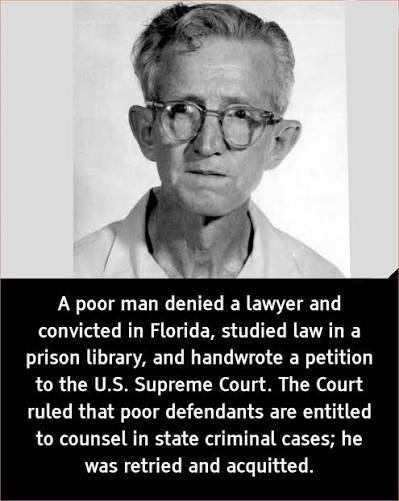
But his legacy walked with him. Because of one man’s pencil-written petition, the American justice system fundamentally transformed. States across the country had to create public defender offices. Thousands of prisoners convicted without lawyers got new trials. The principle that justice should not depend on wealth became law.
Gideon himself returned to his quiet life. He married for a fifth time. He struggled with health issues. When he died of cancer on January 18, 1972, at age 61, he was still poor. His family initially buried him in an unmarked grave in Missouri.
But years later, the ACLU placed a granite headstone on that grave. The inscription came from Gideon’s own words in a letter to Abe Fortas: “Each era finds an improvement in law for the benefit of mankind.”
Today, every single time you hear the words “you have the right to an attorney, and if you cannot afford one, one will be appointed to you”—those words exist because one man refused to accept that poor people should face justice alone.
Clarence Earl Gideon proved that the most powerful force for change isn’t wealth, status, or education. Sometimes it’s simply the courage to pick up a pencil and write: “This is not right.”
And sometimes, against all odds, the world agrees.
*****************
Those last lines are worth repeating:
Clarence Earl Gideon proved that the most powerful force for change isn’t wealth, status, or education. Sometimes it’s simply the courage to pick up a pencil and write: “This is not right.”
And sometimes, against all odds, the world agrees.
It might be a pencil... it might be your voice... it might be on your computer.
ALL of us need to have the courage to fight for what is right. I hope you’ll join me!
****************************

Have you made me cry?? Or laugh?? Or made me so very glad I have the best readers in the world??
If you’ve written a review of one of my books, you probably did. :) Every time I get a little overwhelmed by the pressures of research or writing, I go to Amazon and read my Reviews. They never fail to give me the motivation and energy to continue forward.
As I bring # 22 (Lifted By The Wings of Destiny) to life, it would mean the world to me if you would go and leave a review for one (or more) of The Bregdan Chronicles. I will consider it a personal message from you to me...
I’m even going to make it easy for you. :)
Write a Review for Storm Clouds Rolling In
Write a Review for On To Richmond
Write a Review for Spring Will Come
Write a Review for The Last, Long Night
Write a Review for Carried Forward By Hope
Write a Review for Glimmers of Change
Write a Review for Shifted By The Winds
Write a Review for Always Forward
Write a Review for Walking Into The Unknown
Write a Review for Looking To The Future
Write a Review for Horizons Unfolding
Write a Review for The Twisted Road of One Writer
Write a Review for Misty Shadows of Hope
Write a Review for Shining Through Dark Clouds
Write a Review for Courage Rising
Write a Review for Renewed By Dawn
Write a Review for Journey To Joy
Write a Review for Courage To Stand
Write a Review for Walking Toward Freedom
Write a Review for Gateway To A New Beginning
Thank you for making it possible for me to write The Bregdan Chronicles!
Blessings,
Ginny Dye